PL. 012026system · product
A platform that rebuilds a website as a design file
Reconstructing any page into native Figma structure — auto-layout and real grids — with fidelity measured as a build gate, not a claim.
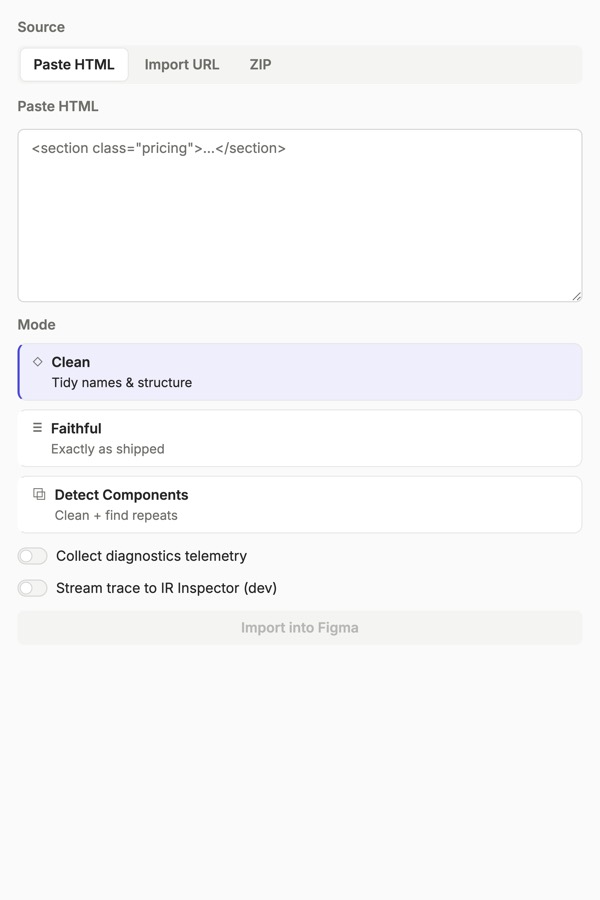 Four ways in — a URL, a browser capture, HTML or a ZIPThe capture service opens the page; Reweave rebuilds itEvery screen size at once, each its own frameClean — tidies names and structureFaithful — exactly as shippedDetects repeats and promotes them to componentsEmits native auto-layout and Grid
- Four ways in — a URL, a browser capture, HTML or a ZIP
- The capture service opens the page; Reweave rebuilds it
- Every screen size at once, each its own frame
- Clean — tidies names and structure
- Faithful — exactly as shipped
- Detects repeats and promotes them to components
- Emits native auto-layout and Grid
Constraint
A designer handed a live website has two bad options: trace it by hand, or paste a screenshot. Both discard the structure that makes a file editable — the layout rules, the spacing intent, the repeats. Any tool that rebuilds the page has to reconstruct that intent, and it has to be able to prove how close it got, on every commit, or the claim is worthless.
Decision
We reconstruct into native Figma primitives rather than flat frames, and we treat fidelity as arithmetic. A 66-page corpus is rasterised and scored on every run — layout, typography, spacing, and structural similarity against the source — and the score is a CI gate. CSS Grid reconstructs into native Figma Grid rather than being flattened to stacks (ADR-041).